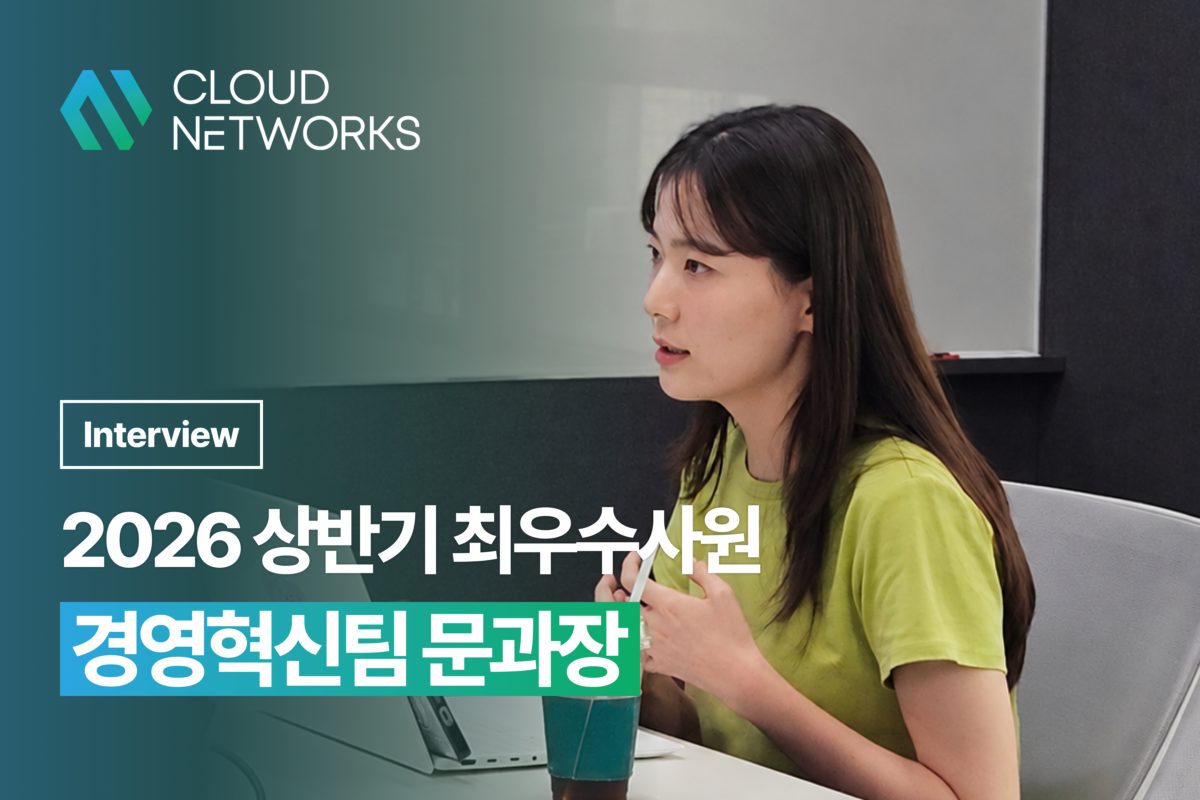
2026 First-Half Outstanding Employee Interview – Manager Mun, "Cool Head, Warm Heart"
We conducted an internal interview with Manager Mun of the Management Innovation Team, who was selected as CloudNetworks' Outstanding Employee for the first half of 2026.Having gone through this company's hiring process herself as an applicant, she is now in the position of designing that very process. From introducing recruitment solutions to streamline processes, to having regular lunches with new hires to check in on their adjustment, to making sure the newly established core values become the actual language of everyday work — we introduce the story of Manager Mun, who is refining, step by step, the entire journey from application to joining to settling in. 🏆 CloudNetworks Internal Interview – Manager Mun, Management Innovation Team Q. Please give us a brief introduction and tell us about your current role on your team.Hello, I'm Manager Mun from the Management Innovation Team at CloudNetworks, where I handle HR work. I oversee HR broadly, from recruitment to payroll to organizational culture. Q. What led you to join CloudNetworks? As someone whose job is recruitment, you must have had certain criteria when choosing a company.While doing HR work, I came to feel that organizational culture is important for a company's growth. However, feeling that organizational culture matters and actually being in an environment where HR can do something about it are two different things. Even when the HR team tries various initiatives, they're difficult to carry out without management's interest and commitment. So that was the most important thing I looked at when choosing a company.As I was preparing to change jobs, I looked through job postings and websites for several companies. Among them, CloudNetworks was very actively engaged in organizational culture initiatives. When I found and read an interview with the CEO, I could really sense the level of interest and commitment in that area. So I really wanted to come here, and I remember preparing hard for the interview. Q. What was the hiring process like from an applicant's perspective?After passing the document screening, there was a pre-interview questionnaire I had to complete before the first interview. It broke HR work down into specific categories and checked what level of experience I had in each, along with a few essay-type questions. It could feel like a bit of a burden, but since I really wanted to join this company, I filled it out diligently. I also felt it was a chance to show how much genuine thought and research I had put in. The more I researched the company while preparing, the stronger my desire to join became. Above all, the process itself gave me the impression that the company approached hiring very systematically. I think the hiring process reflects how a company works, and I felt that they deliberated carefully over each hire, which gave me more trust in the company. Q. How is CloudNetworks different when viewed from the outside as a job seeker versus from the inside as a recruiter now?Even from the outside, I had the impression it was a good company. I could see it was constantly trying new things and developing, and that the benefits weren't just words but were actually being implemented. After joining, I felt this even more. We're actively running various benefit programs and HR activities, and I work to make sure that continues. Because of this, I find myself wishing applicants could sense these things even before joining. When I talk to people who joined recently, they tell me that job postings and benefit descriptions alone didn't stand out much, since other companies list similar-sounding phrases on their sites. But once they actually experience it here, they say it feels different — there are no hidden conditions or need to feel self-conscious about using the benefits. As a recruiter, I keep thinking about how to let applicants know that difference in advance. Q. As an HR manager, what do you consider most important when evaluating a candidate?Regardless of job function, what I commonly look for is whether the person fits well with our company. Since the people already working here come first, I look at whether the candidate would get along well with them. I tend to ask various questions — about hobbies, or for experienced hires, how they got along with colleagues at their previous company. Through these conversations, I get a sense of whether the candidate's disposition would fit well with our company. That said, it's a sense that can't be turned into data, and I don't think my judgment is always right, so I try to share my opinion carefully. Q. What characteristics do engineering, sales, and management roles each have, and how does your approach to hiring differ for each?For engineering roles, we're hiring a lot of new graduates and juniors these days, and applicants tend to already have strong interest in the field. Many have obtained certifications or done things like bootcamps. So the team leads or mentors who join the interviews check how much of that experience has actually stuck with the applicant — how much has genuinely become their own. Even if a resume lists a lot, sometimes the applicant only handled part of it or only understood it superficially. As the HR manager, what I ask about is their enthusiasm for the role and whether they sufficiently understand that the working environment can change depending on the project.For sales roles too, we hire a lot of new graduates and juniors, and the hiring managers focus on checking how the candidate understands the sales role and where their interest and passion come from. I think that's also why we run some sales hiring through intern-to-hire tracks — the company needs time to evaluate the person, and the new hire also needs time to see whether sales suits them.For management roles, we look at it similarly to engineering — how much preparation the person has done and what they were thinking as they did that work. Even if they lack the exact experience we want, we look at what they learned from the experiences they did have and how they tried to fill in gaps, to see if they're the type of person who keeps growing. Q. CloudNetworks has a relatively low turnover rate. Do you notice any common traits among long-tenured employees?There's a sense that they're experts in their field. They're experts in their area of responsibility and take pride in it. I'd say the overall atmosphere feels very professional. At our company, even the team leads and department heads work very busily.I think the low turnover comes from the fact that everyone looks out for one another. Team leads take care of each team member individually, team members watch out for each other, and management stays engaged as well. HR is also always keeping an eye on whether someone is doing well. Unless there's a clear reason like work style or career direction, people usually leave because of interpersonal issues — and our team leads are very attentive to that. Q. You recently introduced a recruitment solution. What kind of changes did you want to bring for both applicants and hiring managers in the process?For hiring managers, the biggest change is being able to view applications in one place. Previously, since job postings were listed on multiple sites, applications also accumulated separately on each site. Department heads had to check each site individually and consolidate the results, and if someone applied through two channels, we sometimes ended up reviewing the same person twice. Teams that received a high volume of resumes felt this burden the most, but now, regardless of which channel someone applied through, everything can be checked on a single screen.On the other hand, we tried not to change what applicants experience. The system has a feature that lets applicants schedule their own interview times, but after a lot of deliberation, we're not using it right now. I felt that if I were an applicant, being notified only through a system would feel a bit cold. Among the many features, some fit us well and some don't, so we're continuing to think carefully about which features to use and how.Q. What new initiatives have you been leading in HR since joining?I've been working continuously to improve the onboarding process. As hiring scaled up and more new employees started joining, I felt the early period was extremely important. Thinking about how to help them settle in well, I broke down and refined the materials used to introduce the company and provide training. We now have separate materials for the company introduction and for training.For newcomers, everything — Outlook, Teams, the groupware — is new to them, so briefly walking them through the frequently used features makes it much easier for them to adjust to work. At first, we ran this all at once for about an hour and a half, but I noticed that since people were nervous, their concentration would drop. So we split it — doing part in the morning and continuing with the rest in the afternoon. Q. What was the thinking behind having regular lunches with new hires after they join?During the application stage — interview scheduling, and early onboarding — there's a lot of contact with the HR team, but after that, contact becomes almost nonexistent. I thought that if new hires felt they had one more channel to consult when questions or concerns about the company came up, it would help them settle in better. And for that, regular meetings seemed necessary. It's not just something new hires want — as someone in recruitment and HR, I'm also curious whether they're adjusting well. And through these sessions, I also get to learn how each team introduces work to their new hires.There was also an opinion from the Junior Board that it would be nice to have a buddy-type system in addition to a mentor. Many companies run such programs, but selecting and training buddies takes real time and effort. So for now, I felt it made more sense for me to do it directly, which is how the HR new-hire lunch meetings started.Q. Why did you choose the format of lunch rather than a formal one-on-one meeting?I also considered coffee chats, but those require carving out separate time in the middle of work, and conversations tend to become too serious and in-depth. I was concerned that could feel like a burden to new hires, and I really wanted the conversations to feel more relaxed. Over a meal, people don't only talk about work — things like how they're doing, how they spend their free time, also come up naturally. Q. Do different topics come up depending on the timing?Yes, they differ. At the one-month mark, people are busy just adjusting to the company itself. Since both the company and the work are new, it's a period full of worry about whether they'll adjust well. What feels difficult at that stage isn't the company itself being hard, but the difficulty that comes from being nervous and from the adjustment process itself. Around three months, they've settled in somewhat, so the conversation shifts to work — how their work is going, how their relationships with other employees are. Around six months, they talk about concerns like an increased workload or being assigned a new project. By then, they've grown close with colleagues and are working hard. Q. Were there any unexpected reactions?The fact that people responded positively was itself unexpected. I thought some might find it bothersome. If HR suggests having a meal together, some might get nervous, wondering if something's wrong. In fact, at the one-month mark, some people wondered if they had done something wrong. I started with mixed expectations, but more people than I anticipated seemed satisfied, which I'm glad about. Q. With the Junior Board, Diagonal Slice meetings, and HR meetings, you seem to have many opportunities to talk directly with employees. Do different topics come up in each setting?Yes, they differ. The Junior Board* is made up of employees at the assistant-manager level and below, and it covers company-wide topics. Sometimes the members themselves decide on topics to discuss, and sometimes we bring questions to them when there's a company-wide matter. At first, I thought people might participate just for form's sake, but they genuinely engage with real enthusiasm. Engineers even seriously discuss how they can share the knowledge each of them holds. I think the reason people participate so actively is that their input actually gets reflected. If it were just talk that ended up only in meeting minutes, people wouldn't put in this much effort. Because HR and the CEO genuinely review the input and give feedback, whatever is applicable actually does get applied to the company. Looking back at last year alone, I'd say about half of the opinions raised were reflected in some way.The Diagonal Slice meeting** was originally a setting for discussing the company in general, but as the company has grown, it's taken on another meaning. Since engineers often work off-site, there are cases where they only get to see each other at company-wide workshops or all-hands meetings. So now, this setting also serves as an opportunity for employees to get to know each other's faces and talk. People say that once they've met and talked once, things feel more comfortable afterward, and reaching out for work-related matters becomes easier than before.The HR team meetings started as the organization grew, as a way to check in on how each team is working and whether there are any issues. It lets me see how each team operates and what cycle they work in, so I can understand each team's distinct characteristics — as the HR person in charge, this has been the most useful time for me.* Junior Board: An internal council made up of non-managerial employees at the assistant-manager level and below, which reports improvement proposals from its discussions to a steering committee for reflection in management decisions.** Diagonal Slice meeting: A gathering, in the form of a meal and discussion session, that randomly selects employees across different departments, positions, and ranks to communicate with one another. Q. You are leading the internalization activities for the newly established mission, vision, and core values this year. What did you think was needed to make the core values into language actually used in everyday work?I felt that establishing and announcing the mission, vision, and core values wasn't the end — that's actually when the real work begins. So I thought the most important thing was for employees to be continuously exposed to them. I thought about how to make this happen naturally during work, so that people would keep being reminded of them, and while looking for a way to do that, I came up with the idea of sharing each person's practical examples at the Diagonal Slice meetings.Honestly, I don't think the mission, vision, and core values we established are something completely new that didn't exist before. I think they're a matter of looking at how we've already been working and putting what was already there into words. So it's less like a new story and more like something people already know. Still, precisely because it's now been put into words, it's important that it stays present in people's minds. In the busyness of everyday work, it's easy to lose sight of it. People find it difficult at first, but as they share their own examples, it also becomes a time to learn how other teams are working and what kind of work they're doing these days. Q. Among the four core values, is there one you see as especially central?Although they're divided into four, I think they're all interconnected. Continuous growth and innovation are needed to build trust with our client companies and to fulfill the responsibility that comes with that, and that requires integration and collaboration between teams and team members.The CEO once mentioned that our engineers' capabilities are well regarded wherever they go. As that kind of recognition accumulates, it builds trust in the company and its people, and that in turn increases each person's sense of responsibility for their role. And underlying all of that, I think, are expertise and excellence. Here, expertise doesn't just mean doing your assigned work well — it also includes communicating smoothly with client companies and collaborating well with teammates. Q. Following your selection as Outstanding Employee for the first half, you were also promoted to Manager. What were your thoughts on that?Since I wasn't expecting it at all, I was very surprised to hear I had been selected. I joined last September, and while adjusting to and learning about the company, I tried various things in my own way — I was truly grateful that these efforts were viewed favorably. The promotion news was also unexpected. The announcement happened to go up on a day I was on leave, so I only found out later after receiving congratulatory messages. Since I've been viewed so favorably, it made me think I need to work even harder going forward. Q. Finally, is there anything you'd like to say to your colleagues?I'd like to thank the Management Innovation Team and related teams for arranging this interview, and especially my team lead, who always supports me so that I can adjust well and do my work at the company. I'd also like to thank all our employees. When HR runs various campaigns or activities, if employee participation or interest is low, they lose their meaning. But the employees at our company always show interest and participate enthusiastically, which is why I feel the various activities we're running now are able to meaningfully contribute to the company's development. It's been an unusually hot summer this year, and everyone has worked hard in their own place. I hope everyone takes care of their health and keeps up the good work — I'll do the same. Q. If you were to express your attitude toward work, or the value you consider most important, in one sentence, what would it be?My mission is "cool head, warm heart." It's the same sentence I mentioned during my interview. HR work involves a lot of documentation, laws, and regulations, so there are truly many moments that require objective judgment based on principles and standards. But at the same time, I believe HR is ultimately about understanding people and finding answers for people. B-cut — Cool head, warm heart, hot baseball ✏️ Editor's note: HR work touches every member of the company. Even if the deliberation behind it isn't visible, its results are something each individual employee experiences. The fact that she received the most votes in the company-wide vote suggests that these efforts have genuinely reached people.Throughout the interview, Manager Mun consistently thought from the other person's perspective. When introducing the recruitment solution, she considered how applicants would feel about it; when creating a setting to meet new hires, she thought carefully about a format that wouldn't feel burdensome to them. In the various settings where she listens to feedback, she seemed to care more about whether the input actually gets reflected than about what was said. It was striking how she began looking at and refining points that are easy to overlook because they aren't visible on the surface.Cool head, warm heart. Just as her mission suggests — judging by principle and standard, while ultimately seeking answers for people — we look forward to the changes that CloudNetworks employees will encounter ahead.CloudNetworks selects its Outstanding Employee and Excellent Employees through a company-wide vote each half-year and shares their stories through internal interviews. Employees who build expertise in their own roles, take full responsibility for their work, and trust and collaborate with one another are the ones shaping CloudNetworks' culture and way of working. Check out more stories.
September 14, 2026